
The Fan, the Buzz, and the Ghost of Rickshaw Interference
By Khawar Nehal
Date : 19 September 2026
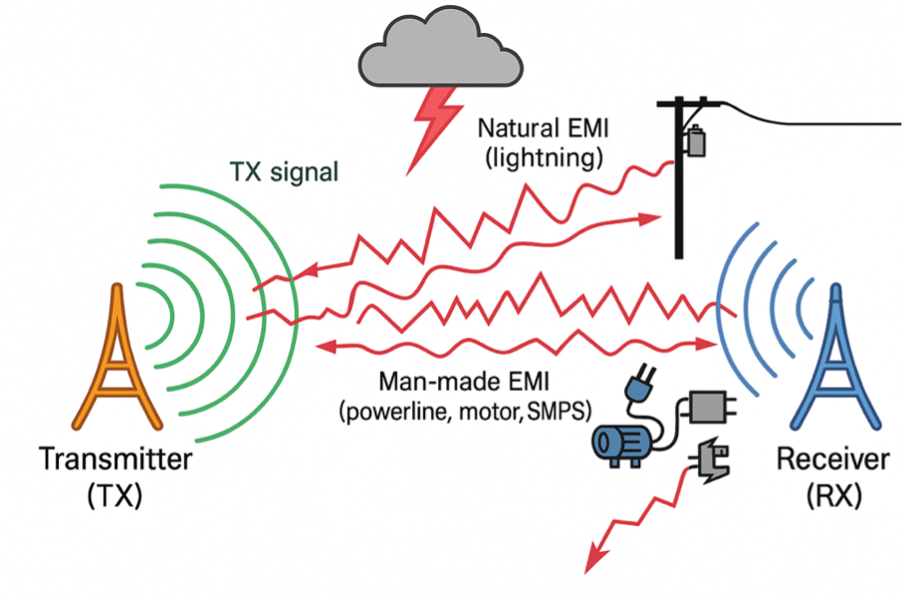
I was in the middle of a Vokoscreen recording — one of those quiet, focused sessions where you’ve finally gotten the levels right, the room is still, and the waveform on your screen looks like a calm river. Then the doorbell rang. Or rather, a Gen Z kid from next door showed up at the gate, the way Gen Z kids do: unannounced, unhurried, and entirely unbothered by the concept of appointments.
I left the recording running. A mistake, you’d think. But it turned out to be the best accident of the week.
I walked out, opened the door, let him in, exchanged the usual pleasantries, and eventually came back to wrap up the session. It was only later, during editing, that I noticed it — a faint, persistent buzz creeping into the audio track. Not loud. Not obvious. The kind of thing most people would slap a noise gate on and forget about. But it wasn’t there before I left the room. It arrived at exactly the timestamp I got up to open the door.
So I did what anyone from my generation would do. I started asking questions.
“What did you turn on when you came in?” I asked him.
He thought for a moment. “Uh… the computer. The lights. And the fan.”
Three suspects. The computer was unlikely — modern switching power supplies are reasonably well-shielded. The lights were LEDs, no ballast hum to speak of. That left the fan. A ceiling fan with a motor, a capacitor, and decades of accumulated dust on its blades — a beautiful little electromagnetic troublemaker.
I turned the fan off. Hit record again. Silence. Clean, pristine silence. Turned it back on. The buzz returned like an unwelcome relative at a wedding.
Isolated. Confirmed. Case closed in under five minutes.
The kid looked at me with genuine bewilderment. “Wait — you have a fan in your room too,” he said, pointing toward my setup. “How do you know it’s not yours?”
“Because mine was off,” I said. “I turn it off every time I record. Noise suppression. Basic hygiene.”
He raised an eyebrow. I checked anyway, just to be thorough. My fan, an almost identical model, produced nothing but a gentle breeze and zero electromagnetic grief when powered on. Different wiring, different grounding, different age of the motor — who knows. But it wasn’t the culprit. The evidence was clean.
That’s when the kid said something that made me pause.
“I can’t believe you guys diagnosed a mic buzz that fast and went that deep into it. I would’ve just Googled ‘how to remove buzz in Audacity’ and spent two hours with plugins.”
I laughed. And then I told him why.
We come from a different time.
I’m talking about the era when a rickshaw passing outside your house could turn your television into a snowstorm. You’d be watching PTV, right in the middle of a drama, and suddenly — krrrrshhhhh — a wave of white noise would wash across the screen, accompanied by a sound like someone frying gravel in a tin pan. And you knew, without looking out the window, that a rickshaw had just coughed its way down the street. The spark plug. The ignition coil. The unshielded chaos of a two-stroke engine broadcasting electromagnetic interference across the AM spectrum like a pirate radio station nobody asked for.
Those were the days when radios hissed when you flipped a light switch. When your television antenna was a coat hanger and your signal quality depended on which direction the wind was blowing and whether your neighbor had just turned on his washing machine. When “debugging” wasn’t a metaphor — it was literally tracing a signal path through a tangle of coaxial cables, checking ground loops, and figuring out which appliance in the house was leaking noise into your audio chain.
We didn’t have noise reduction plugins. We had ears. And we had patience. And we had a deep, almost superstitious respect for the invisible electromagnetic soup we all lived in.
I told him about Comsats.
This was the 1990s. I was working with a setup where our modem — a dial-up beast that screamed and screeched its way into a connection like a cat being dragged across a chalkboard — kept getting stuck. Not dropping. Not timing out. Stuck. Frozen in a handshake that never completed, as if the two modems were staring at each other across the phone line in mutual confusion.
The modem on our end was fine. The line was fine. The problem, it turned out, was on the other side — at a company called Comsats, which was another ISP we were trying to interconnect with. Their modem would lock up at seemingly random intervals, and nobody there could figure out why.
So I started keeping a log. Timestamps. Durations. Ambient conditions. And a pattern emerged that was so absurd, so beautifully analog, that nobody believed it at first.
Every time their air conditioner compressor kicked in, the voltage spike was just enough to destabilize their modem’s power supply. The modem wouldn’t crash outright — it would just freeze, caught in a limbo state, its little LEDs blinking in a pattern that looked normal but meant absolutely nothing. The fix? I had to call the other side — an actual phone call, to an actual human being — and ask them to power-cycle their modem. Every. Single. Time.
When I finally explained the root cause to the team at Comsats, the silence on the other end of the line was louder than the modem’s dial tone.
“The air conditioner?” they said.
“The air conditioner,” I confirmed.
People were astonished. In the 1990s, the idea that an HVAC system could interfere with a data connection seemed almost medieval. But it wasn’t medieval. It was physics. And physics doesn’t care about your OSI model.
The Gen Z kid listened to all of this with the expression of someone hearing a folk tale about a world that existed before smartphones. He couldn’t quite fathom a reality where you had to listen to your equipment, where interference was a daily companion, and where the solution to a networking problem might involve asking someone to turn off their AC.
And I couldn’t quite fathom a world where you could spend two hours with a noise reduction plugin and never once wonder where the noise was coming from.
We’re both right, of course. His tools are miraculous. My instincts are archaic. But there’s something to be said for a generation that learned to hear the invisible — to know that a rickshaw’s spark plug could ruin your evening, that a ceiling fan could ruin your recording, and that an air conditioner on the other side of the city could ruin your modem.
The buzz is always there. You just have to know how to listen for it.
And maybe, just maybe, know when to turn off the fan.
Khawar Nehal is a technologist, storyteller, and veteran of the analog-to-digital transition who still checks his ground loops before hitting record.
