
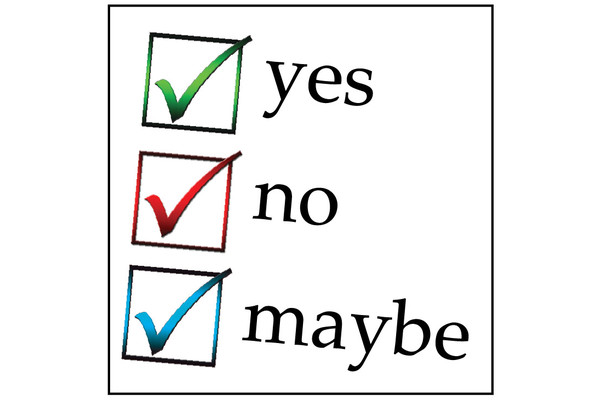
Options available for decision items.
Here is a structured, detailed outline of decision options for future plan selection, with exactly one-line explanations for each:
I. Core Decision Options
-
Yes → Proceed immediately as the item aligns with goals and resources are available.
-
No → Reject the item due to misalignment, high risk, or poor return on investment.
-
Maybe → Keep under consideration pending additional data, validation, or stakeholder input.
-
Not Sure → Pause evaluation until feasibility, impact, or ownership can be clearly determined.
-
Maybe in the Future → Delay action until specific market, financial, or operational triggers occur.
-
Depends → Condition approval on external variables, internal capacity, or prerequisite outcomes.
II. Priority & Execution Status
-
Required → Mandatory for legal, compliance, security, or core operational continuity.
-
Not Required → Optional or redundant item that does not impact current objectives.
-
High Priority → Critical path item demanding immediate focus and resource allocation.
-
Medium Priority → Important but flexible item that can be scheduled within standard planning cycles.
-
Low Priority → Beneficial but non-urgent item suitable for backlogged or opportunistic execution.
-
Defer → Postpone intentionally to avoid resource strain or wait for optimal timing.
-
Reject → Formally discard after evaluation confirms lack of strategic or operational value.
-
On Hold → Temporarily suspended due to shifting priorities, external constraints, or internal review.
-
Cancelled → Permanently terminated after deciding the item no longer serves organizational needs.
III. Conditional & Dependency States
-
Research First → Requires fact-finding, market analysis, or technical validation before proceeding.
-
Pilot/Test First → Validate through a small-scale experiment or limited rollout before full commitment.
-
Conditional Yes → Approved only if predefined criteria, budgets, or partnerships are secured.
-
Conditional No → Rejected unless specific mitigating factors or new opportunities emerge.
-
Pending Approval → Awaiting sign-off from leadership, legal, finance, or external partners.
-
Pending Resources → Blocked until funding, personnel, or tooling becomes available.
-
Pending Market Signal → Held until customer demand, competitor moves, or economic indicators shift favorably.
IV. Strategic & Scope Alignment
-
Strategic Fit → Directly advances long-term vision, positioning, or competitive advantage.
-
Tactical Fit → Supports immediate operational goals, process improvements, or short-term wins.
-
Nice-to-Have → Enhances user experience or workflow but is not essential for delivery.
-
Must-Have → Non-negotiable component required for product, service, or compliance baseline.
-
Legal/Compliance Must → Driven by regulatory obligations, contractual terms, or risk mitigation mandates.
-
Risky — Proceed with Caution → High potential reward but requires safeguards, monitoring, or exit criteria.
-
Out of Scope → Falls outside current project boundaries, entity focus, or strategic mandate.
-
Revisit Next Quarter → Schedule for formal re-evaluation during the next planning cycle.
-
Assign Owner First → Cannot progress until a responsible individual or team is designated.
-
Budget-Dependent → Execution hinges on securing or reallocating financial resources.
-
Partner-Dependent → Requires collaboration, integration, or approval from external organizations.
-
Client-Validated → Proceed only after direct customer feedback confirms demand or usability.
-
Internally Driven → Initiated based on organizational capacity, innovation goals, or process needs.
V. Binary & Quick-Response Tags
-
✅ / ❌ → Simple visual shorthand for approved versus rejected items in tracking systems.
-
Go / No-Go → Clear milestone checkpoint for proceeding or halting based on readiness criteria.
-
Do / Don’t → Straightforward directive for immediate action versus explicit non-action.
-
Now / Later / Never → Time-based triage indicating immediate execution, delayed scheduling, or permanent dismissal.
VI. Scoring & Prioritization Frameworks
-
1–5 Priority Scale → Quantifies importance numerically for easy sorting and resource allocation.
-
Impact: Low / Medium / High → Estimates the potential business value or outcome magnitude.
-
Effort: Low / Medium / High → Gauges the time, cost, or complexity required for execution.
-
Confidence: Low / Medium / High → Reflects certainty in projected outcomes, data quality, or feasibility.
-
RICE Score → Multi-factor metric combining Reach, Impact, Confidence, and Effort for objective ranking.
-
MoSCoW → Categorizes items as Must, Should, Could, or Won’t for agile prioritization and scope control.
You can copy this directly into a spreadsheet, Notion database, or decision tracker. Let me know if you need it formatted as a dropdown list, validation sheet, or interactive matrix.
Options available for decision items.
https://nextcloud-atrc.remote-support.space/index.php/s/EepC7dwTas2BMwJ
https://nextcloud-atrc.remote-support.space/index.php/f/1964262
