
CELSIUS 95: When AI Companies Destroy the Original
How Modern Tech Dystopia Mirrors Our Greatest Warning Tales
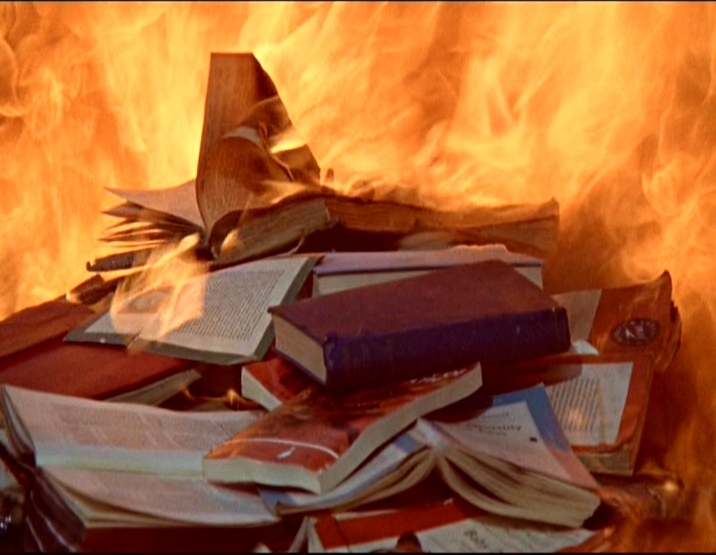
In Ray Bradbury’s Fahrenheit 451, the temperature at which book paper burns became a symbol of state-sponsored ignorance. But in the modern era of artificial intelligence, a new dystopia emerges at a different temperature: Celsius 95 (Fahrenheit 203)—the point at which computer GPUs overheat and throttle while consuming human knowledge.
Recent revelations show that AI companies like Anthropic and Amazon have been systematically purchasing physical books, scanning them for AI training data, and then physically destroying the originals to save on storage costs. This isn’t just digitization; it is the erasure of humanity’s original texts, replacing them with corporate-controlled digital abstractions. As one internal memo revealed, Anthropic’s “Project Panama” was described as “our effort to destructively scan all the books in the world,” conducted in secret because the company did not want it to be known they were doing it.
This modern book-burning echoes the darkest warnings of dystopian fiction. But unlike Bradbury’s firemen or Orwell’s Thought Police, today’s knowledge destroyers operate under the guise of “innovation” and “fair use,” achieving through market forces and legal loopholes what tyrants once required violence to accomplish.
Part I: The Classics That Predicted This
Fahrenheit 451 (1953) – The Original Warning
Bradbury’s masterpiece depicted a future where “firemen” burned books to suppress dissenting ideas and enforce conformity. The novel’s horror wasn’t just the destruction itself, but the replacement of authentic knowledge with shallow, state-approved entertainment delivered through wall-sized television screens.
The Parallel: Today’s AI companies don’t need firemen. They achieve the same result by buying books, extracting their essence into training data, and shredding the physical originals. The public loses access to verifiable sources, left only with AI-generated outputs that may subtly distort, oversimplify, or homogenize human knowledge.
Harrison Bergeron (1961) – The Handicapping of Excellence
Kurt Vonnegut’s chilling tale depicted a society where the government enforced absolute equality by physically handicapping anyone with natural advantages. The strong wore weights, the intelligent wore ear radios that blasted disruptive noises, and the beautiful wore masks. Crucially, access to the “original,” unaltered state of human excellence was strictly forbidden. When the protagonist briefly removes his handicaps on live television to show the public what an unburdened human can do, he is immediately executed.
The AI Parallel: By destroying original books and locking knowledge inside proprietary models, AI companies “handicap” the public from accessing authentic, unfiltered human thought. We are forced to consume AI-mediated versions of literature—smoothed, sanitized, and controlled—while the raw, challenging originals are literally shredded.
1984 (1949) – Who Controls the Past
George Orwell’s dystopia gave us the ultimate warning: “Who controls the past controls the future. Who controls the present controls the past.” In Oceania, the Ministry of Truth constantly rewrote historical records to match the Party’s current narrative, destroying original documents in “memory holes.”
The Modern Manifestation: When AI companies destroy original books after scanning them, they create a similar control mechanism. Future generations won’t be able to verify AI outputs against original sources because those sources no longer exist. The corporations that control the training data control the narrative, able to subtly reshape human knowledge without anyone able to fact-check against the original.
Part II: The Forgotten Masterpieces
The Memory Police by Yōko Ogawa (1994)
This haunting novel depicts an unnamed island where things disappear—not just physically, but from memory itself. First roses vanish, then photographs, then calendars, each disappearance enforced by the sinister Memory Police who ensure no one remembers what was lost.
The Chilling Parallel: The AI book destruction scandal creates a similar slow erasure. As original texts disappear into corporate servers, future generations may not even know what knowledge has been lost. The “Memory Police” of our age aren’t fascist officers; they are terms of service, copyright law, and the quiet efficiency of industrial shredders.
Equilibrium (2002 Film)
This underrated sci-fi film depicted a future where emotions were outlawed and all “artifacts” of human feeling—books, art, music—were systematically destroyed in mass burnings. The protagonist, a clerical enforcer, begins to question the regime when his partner secretly saves a book of poetry from incineration.
The Connection: Like the book-burning enforcers in Equilibrium, modern AI companies position themselves as neutral processors of information while systematically eliminating the physical sources. The difference? Instead of burning books for ideological purity, they destroy them for “efficiency” and “cost savings,” making the erasure even more insidious because it is framed as practical rather than tyrannical.
The Giver (1993)
Lois Lowry’s novel presented a society that eliminated pain by erasing all collective memory, with only one person—the “Giver”—holding the memories of color, emotion, war, and love. The community lived in “Sameness,” unaware of what they had lost.
The AI Parallel: As AI companies consolidate human knowledge into proprietary models, they become the new “Givers”—the sole holders of humanity’s written works after destroying the originals. The public receives only processed, sanitized versions of knowledge, unaware of the richness, complexity, and diversity that existed in the original texts.
Part III: Memory, Reality, and Control
Dark City (1998)
This noir-tinged sci-fi masterpiece depicted a city where mysterious “Strangers” manipulated reality itself, rewriting the architecture nightly and implanting false memories into the population. No one could trust their own past because it was being constantly rewritten by unseen forces.
The Modern Version: When original books are destroyed and replaced with AI-generated summaries or interpretations, our collective memory is similarly rewritten. We lose the ability to verify what was actually written, leaving us vulnerable to subtle distortions embedded in AI models.
Total Recall (1990)
Philip K. Dick’s story explored memory erasure and implantation, questioning whether our experiences are real or artificially inserted. The protagonist discovers his memories have been suppressed and replaced, unable to distinguish authentic experience from fabrication.
The Connection: As AI models generate increasingly convincing text, we face a similar crisis of authenticity. When the original human-written books are destroyed, future readers won’t be able to distinguish between authentic human thought and AI-generated content. The “implanted memories” aren’t in our brains; they are in our digital libraries.
The Matrix (1999)
The film’s central premise—a simulated reality designed to keep humanity passive while their bodies powered machines—became a metaphor for controlled perception. The Matrix offered a comfortable illusion while the real world decayed.
The AI Parallel: AI-generated knowledge offers a similar comfortable simulation. It is easier to ask an AI for a summary than to read the original text. But this convenience comes at a cost: we are outsourcing our engagement with authentic human thought to systems designed by corporations with profit motives, not truth-seeking goals.
Part IV: The Loss of Civilization
WALL-E (2008)
Pixar’s film depicted a future where humanity had abandoned Earth, leaving behind a civilization’s worth of artifacts—including a treasure trove of books, music, and films that the lonely robot WALL-E cherished. The humans, meanwhile, lived in a sterile, automated existence, having lost connection with culture and knowledge.
The Warning: WALL-E’s careful preservation of physical artifacts contrasts sharply with AI companies’ destructive scanning. The film suggests that physical objects carry meaning beyond their informational content. When we reduce books to mere data to be extracted and discarded, we lose something irrecoverable.
THX 1138 (1971)
George Lucas’s debut film depicted a dystopian future where conformity was enforced through mandatory sedatives, surveillance, and the suppression of emotion. Citizens lived in a controlled, homogeneous society where individuality was chemically suppressed.
The Connection: The destruction of original texts is another form of enforced conformity. When only corporate-controlled AI models provide access to knowledge, diverse perspectives, challenging ideas, and authentic human voices are smoothed into acceptable, non-controversial outputs.
Never Let Me Go by Kazuo Ishiguro (2005)
This haunting novel depicted clones raised for organ harvesting, living in a seemingly idyllic boarding school while unaware of their true purpose. The horror lay in their passive acceptance of a system that treated them as disposable.
The Parallel: The public is similarly kept unaware of what is being lost as AI companies destroy original books. We accept the convenience of AI-generated summaries without realizing that the originals are being permanently eliminated. Like the clones at Hailsham, we are complicit in our own dispossession.
The Road by Cormac McCarthy (2006)
McCarthy’s post-apocalyptic novel depicted the complete collapse of civilization, where the loss of culture, books, and shared knowledge marked the end of humanity itself. The father and son carried “the fire”—a metaphor for preserving human values in a world that had forgotten them.
The Warning: The systematic destruction of original texts is a slow-motion version of The Road‘s cultural collapse. Each shredded book is a small apocalypse, a piece of human civilization extinguished.
Part V: The Fragility of the Digital Archive – Real-World Losses
The dystopian warnings of fiction are not merely theoretical; they are actively unfolding in real-world data loss incidents. When we rely solely on digital copies or outsource our physical archives, we expose humanity’s memory to catastrophic failure.
The Nine PBS 50 TB Crisis
In a stark reminder of digital vulnerability, St. Louis-based public broadcaster Nine PBS recently lost access to 50 terabytes of archival data comprising 70 years of regional television history 1. After their contracted cloud storage vendor went defunct, the irreplaceable footage was held hostage in an Iron Mountain data center, requiring legal intervention just to attempt retrieval 3. This incident proves that “digital preservation” is often an illusion of control, subject to corporate bankruptcy, vendor lock-in, and legal limbo.
The 2008 Universal Studios Fire
While AI companies shred books for “efficiency,” history shows us the cost of losing original masters. In 2008, a fire at Universal Studios Hollywood destroyed an estimated 118,000 to 175,000 master audio recordings, including irreplaceable works by artists like Buddy Holly, John Coltrane, and Nirvana 31, 36. No digital backup could replicate the sonic fidelity, historical context, or cultural provenance of those original physical tapes. It remains one of the greatest tragedies in the history of popular music.
The South Korea Data Center Fire
The illusion of infinite, safe digital storage was further shattered when a fire at a South Korean government data center resulted in the potential permanent loss of 858 terabytes of critical state information 38. Officials confirmed that the destroyed drives were not adequately backed up elsewhere, turning a single physical disaster into a national archival catastrophe 42.
The Internet Archive Breaches
Even institutions explicitly dedicated to digital preservation are not immune. The Internet Archive, a cornerstone of digital cultural memory, suffered multiple cyberattacks and data breaches in 2024, compromising tens of millions of user accounts and highlighting the severe vulnerabilities of centralized digital repositories 47, 52.
These real-world events validate the dystopian warnings: whether through corporate shredding, vendor collapse, physical disaster, or cyberattack, the destruction or loss of the original source is permanent.
Part VI: Resistance, Control, and the Original Copy
V for Vendetta (2005) & Logan’s Run (1976)
V for Vendetta depicted a fascist government that maintained power through the control of information, while the resistance fighter V used the power of forbidden art and literature to fight the regime. Logan’s Run depicted a society kept ignorant of the truth: that “renewal” was a lie, and the system was designed for population control.
The Modern Resistance: The FTC complaint by 18 advocacy organizations represents a form of resistance against corporate knowledge monopolization. Just as V fought to preserve culture from state destruction, advocates are fighting to preserve physical books from corporate erasure. The public is kept ignorant of the true extent of book destruction by AI companies. The “renewal” promised is digital preservation, but the reality is permanent loss.
Blade Runner (1982)
Ridley Scott’s masterpiece questioned what makes something “real” by depicting replicants—bioengineered beings nearly identical to humans. The film’s central tension: if a copy is indistinguishable from the original, does the original still matter?
The AI Question: If an AI can generate text indistinguishable from human writing, do we still need original human-authored books? The answer is yes, because provenance matters. An AI model trained on destroyed originals is like a replicant: it may function, but it has no authentic origin, no soul, and no connection to the human experience that created the knowledge.
Part VII: The Anticompetitive Knowledge Grab
The FTC complaint frames book destruction primarily as an antitrust issue: by destroying physical books after scanning them, wealthy AI companies prevent competitors and the public from accessing those resources. As the complaint states:
“Through their practice of permanently destroying books en masse and thus removing those non-renewable resources from broader access, AI companies are engineering a future where only the wealthiest incumbents can build high-quality AI models and operate as the sole holders of humanity’s written works – after having destroyed the originals to get there.”
This creates a knowledge aristocracy where a few corporations control access to human culture, having eliminated the physical sources that would allow others to compete or verify their claims.
Part VIII: The Legal Shield – “Fair Use” as a Weapon of Destruction
While the physical destruction of books saves on storage costs, a much darker, more calculated motive emerges when we look at copyright law. The physical destruction of the original text isn’t just a logistical choice; it is a deliberate legal strategy to avoid paying authors and to exploit the “Fair Use” doctrine.
Under U.S. copyright law, “Fair Use” is a legal doctrine meant to protect the public good. It allows limited use of copyrighted material without permission for purposes like education, research, and commentary. One of the key tests for Fair Use is whether the new use harms the “potential market” for the original work.
Here is where the dystopian legal loophole opens: If an AI company scans a copyrighted book and keeps the digital file, authors can argue that the AI company has created an unauthorized, competing copy that harms their market. But if the AI company physically destroys the original book immediately after scanning it, their legal argument becomes chillingly airtight.
In the Bartz v. Anthropic copyright case, the district court actually accepted this logic. The court entertained the argument that digitizing a book and then destroying the physical original is a “transformative act of fair use.” The twisted legal reasoning is this: Because we destroyed the physical book, our digital dataset cannot be used by the public to read the book. Therefore, we are not competing with the author’s physical book sales. In fact, by destroying the physical copy, we have removed it from the market entirely, meaning our use is perfectly “fair” and non-infringing.
The Dystopian Parallel: This turns the concept of “Fair Use” on its head. Fair Use was designed by lawmakers to ensure that society could access knowledge, foster education, and allow critics to quote authors. Instead, tech monopolies have weaponized it to do the exact opposite: using the law to justify the physical annihilation of the author’s work.
In Fahrenheit 451, the government burns books to enforce ideological conformity. In the AI reality, corporations shred books to enforce copyright avoidance, using a legal doctrine meant to protect creators as the very justification to erase them.
It is the ultimate corporate perversion of the law. By hiding behind the shield of “Fair Use,” AI companies achieve what the Handicapper General in Harrison Bergeron or the Ministry of Truth in 1984 could only dream of: they don’t just bypass copyright; they use the legal system to mandate the physical eradication of the original text, ensuring that the only surviving “copy” is locked inside their proprietary, un-auditable machine-learning models. They are literally shredding the evidence, and calling it “Fair Use.”
Conclusion: Carrying the Fire
Cormac McCarthy’s The Road ended with the image of carrying “the fire”—preserving humanity’s essence in a broken world. Today, that fire is the physical book, the original text, the authentic human voice unmediated by algorithms.
The dystopian warnings are clear:
- Bradbury warned us about burning books.
- Vonnegut warned us about handicapping excellence and hiding the original.
- Orwell warned us about controlling the past.
- Ogawa warned us about forgetting what disappeared.
- Ishiguro warned us about accepting our own dispossession.
Now AI companies are achieving what these authors feared, not through ideology but through “efficiency,” not through force but through market dynamics and legal loopholes. The temperature isn’t 451°F (232°C) anymore; it’s 95°C (203°F), the point where GPUs overheat consuming human knowledge, then shred the originals to make room for more.
The resistance requires:
- Preserving physical books in libraries, archives, and private collections.
- Demanding transparency about AI training data and legal strategies.
- Rejecting the false choice between technological progress and cultural preservation.
- Remembering that convenience is not worth the cost of losing our originals.
As the FTC complaint notes, we may never know how many destroyed books were “the last or among the last surviving copies of a given work.” Each shredded book is a small act of cultural suicide, a piece of humanity’s memory erased.
The question isn’t whether AI can replicate human knowledge. The question is: When the originals are gone, who controls the truth?
Further Reading & Viewing
Essential Dystopian Works on Knowledge Control:
- Fahrenheit 451 by Ray Bradbury (1953)
- Harrison Bergeron by Kurt Vonnegut (1961)
- 1984 by George Orwell (1949)
- The Memory Police by Yōko Ogawa (1994)
- The Giver by Lois Lowry (1993)
- Never Let Me Go by Kazuo Ishiguro (2005)
- The Road by Cormac McCarthy (2006)
Films on Memory, Reality, and Control:
- Equilibrium (2002)
- Dark City (1998)
- The Matrix (1999)
- V for Vendetta (2005)
- THX 1138 (1971)
- Logan’s Run (1976)
- Blade Runner (1982)
- Minority Report (2002)
- Total Recall (1990)
- WALL-E (2008)
Non-Fiction:
- Burning the Books: A History of the Deliberate Destruction of Knowledge by Richard Ovenden (2020)
