
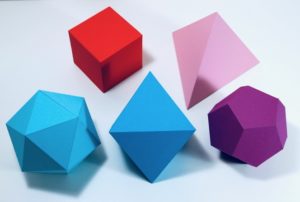
The Platonic solids (Tetrahedron, Cube, Octahedron, Dodecahedron, and Icosahedron) are deeply connected to several specific families of numbers. These relationships span geometry, algebra, group theory, and cosmology.
Here are the primary types of numbers related to the Platonic solids:
1. Polyhedral (Figurate) Numbers
These are sequences of numbers that represent the number of points (or spheres) required to build a solid shape in layers.
-
Tetrahedral Numbers: Represent a pyramid with a triangular base.
-
Sequence: 1, 4, 10, 20, 35, 56…
-
Formula: $T_n = \frac{n(n+1)(n+2)}{6}$ (The sum of the first $n$ triangular numbers).
-
Relation: Directly models the Tetrahedron.
-
-
Hexahedral (Cubic) Numbers:
-
Sequence: 1, 8, 27, 64, 125…
-
Formula: $n^3$
-
Relation: Directly models the Cube.
-
-
Octahedral Numbers: Represent two square pyramids joined at their bases.
-
Sequence: 1, 6, 19, 44, 85…
-
Formula: $O_n = \frac{n(2n^2 + 1)}{3}$
-
Relation: Directly models the Octahedron.
-
-
Dodecahedral & Icosahedral Numbers: While less common in standard curricula, formulas exist for stacking spheres in these shapes, though they do not pack space as neatly as cubes or tetrahedra.
2. Combinatorial Counts (Euler Characteristics)
The most fundamental numbers associated with Platonic solids are their counts of Vertices ($V$), Edges ($E$), and Faces ($F$). These obey Euler’s Formula: $V – E + F = 2$.
|
Solid
|
Vertices ($V$)
|
Edges ($E$)
|
Faces ($F$)
|
Schläfli Symbol ${p, q}$
|
|---|---|---|---|---|
|
Tetrahedron
|
4
|
6
|
4
|
${3, 3}$
|
|
Cube
|
8
|
12
|
6
|
${4, 3}$
|
|
Octahedron
|
6
|
12
|
8
|
${3, 4}$
|
|
Dodecahedron
|
20
|
30
|
12
|
${5, 3}$
|
|
Icosahedron
|
12
|
30
|
20
|
${3, 5}$
|
Patterns in these numbers:
-
Duality: The $V$ and $F$ numbers swap for dual pairs (Cube $\leftrightarrow$ Octahedron, Dodecahedron $\leftrightarrow$ Icosahedron). The Tetrahedron is self-dual ($V=F=4$).
-
Edge Count: The edge count is always divisible by 6 (6, 12, 30).
-
Sum: $V + F = E + 2$.
3. The Golden Ratio ($\phi$) and Irrational Numbers
The geometry of the Platonic solids relies heavily on specific irrational constants, particularly for the Dodecahedron and Icosahedron.
-
The Golden Ratio ($\phi \approx 1.618$):
-
Relation: Intrinsic to the Dodecahedron and Icosahedron.
-
Coordinates: The Cartesian coordinates of an Icosahedron centered at the origin are cyclic permutations of $(0, \pm 1, \pm \phi)$.
-
Ratios: The ratio of the circumradius to the edge length in these solids involves $\phi$.
-
Pentagons: Since the Dodecahedron is made of pentagons, and the diagonal-to-side ratio of a regular pentagon is $\phi$, the solid inherits this number.
-
-
Square Roots ($\sqrt{2}, \sqrt{3}, \sqrt{5}$):
-
Tetrahedron/Cube/Octahedron: Rely on $\sqrt{2}$ and $\sqrt{3}$ for their dihedral angles and radius ratios.
-
Dodecahedron/Icosahedron: Rely on $\sqrt{5}$ (linked to $\phi$).
-
4. Symmetry Group Orders
In group theory, the rotational symmetries of the Platonic solids correspond to specific finite groups. The order of these groups (the number of distinct rotational symmetries) is a key set of numbers.
-
Tetrahedral Group ($T$): Order 12. (Isomorphic to the Alternating Group $A_4$).
-
Octahedral/Cube Group ($O$): Order 24. (Isomorphic to the Symmetric Group $S_4$).
-
Icosahedral/Dodecahedron Group ($I$): Order 60. (Isomorphic to the Alternating Group $A_5$).
Significance: The number 60 is particularly famous in mathematics because $A_5$ is the smallest non-abelian simple group, a foundational building block in the classification of finite simple groups.
5. Kepler’s Orbital Ratios (Historical)
In his 1596 work Mysterium Cosmographicum, Johannes Kepler attempted to relate the 5 Platonic Solids to the 6 known planets (Mercury, Venus, Earth, Mars, Jupiter, Saturn).
-
The Pattern: He nested the solids inside one another, with spheres representing planetary orbits in between.
-
The Numbers: The ratios of the radii of the inscribed and circumscribed spheres of each solid determined the predicted distances between planetary orbits.
-
Outcome: While scientifically incorrect, this linked the number 5 (solids) to the number 6 (planets/orbits) and established a historical link between geometry and astronomy.
6. Kissing Numbers
The “kissing number” problem asks: How many non-overlapping unit spheres can touch a central unit sphere?
-
Cube (Simple Cubic Lattice): The kissing number is 6.
-
Icosahedron (Local Arrangement): In 3D space, the maximum kissing number is 12. This arrangement corresponds to the vertices of an Icosahedron surrounding a center point (though the spheres don’t lock perfectly, allowing “rattling”).
Summary of Key Number Associations
|
Number
|
Association
|
|---|---|
|
4, 6, 8, 12, 20
|
The vertex/face counts of the five solids.
|
|
5
|
The total number of Platonic solids.
|
|
$\phi$ (1.618…)
|
The defining constant of the Dodecahedron and Icosahedron.
|
|
12, 24, 60
|
The orders of the rotational symmetry groups.
|
|
2
|
The Euler Characteristic ($V – E + F = 2$) for all convex polyhedra.
|
|
3
|
The dimension in which exactly 5 regular solids exist (in 4D, there are 6; in 5D+, only 3).
|